Non-B DNA and microsatellite variation and evolution
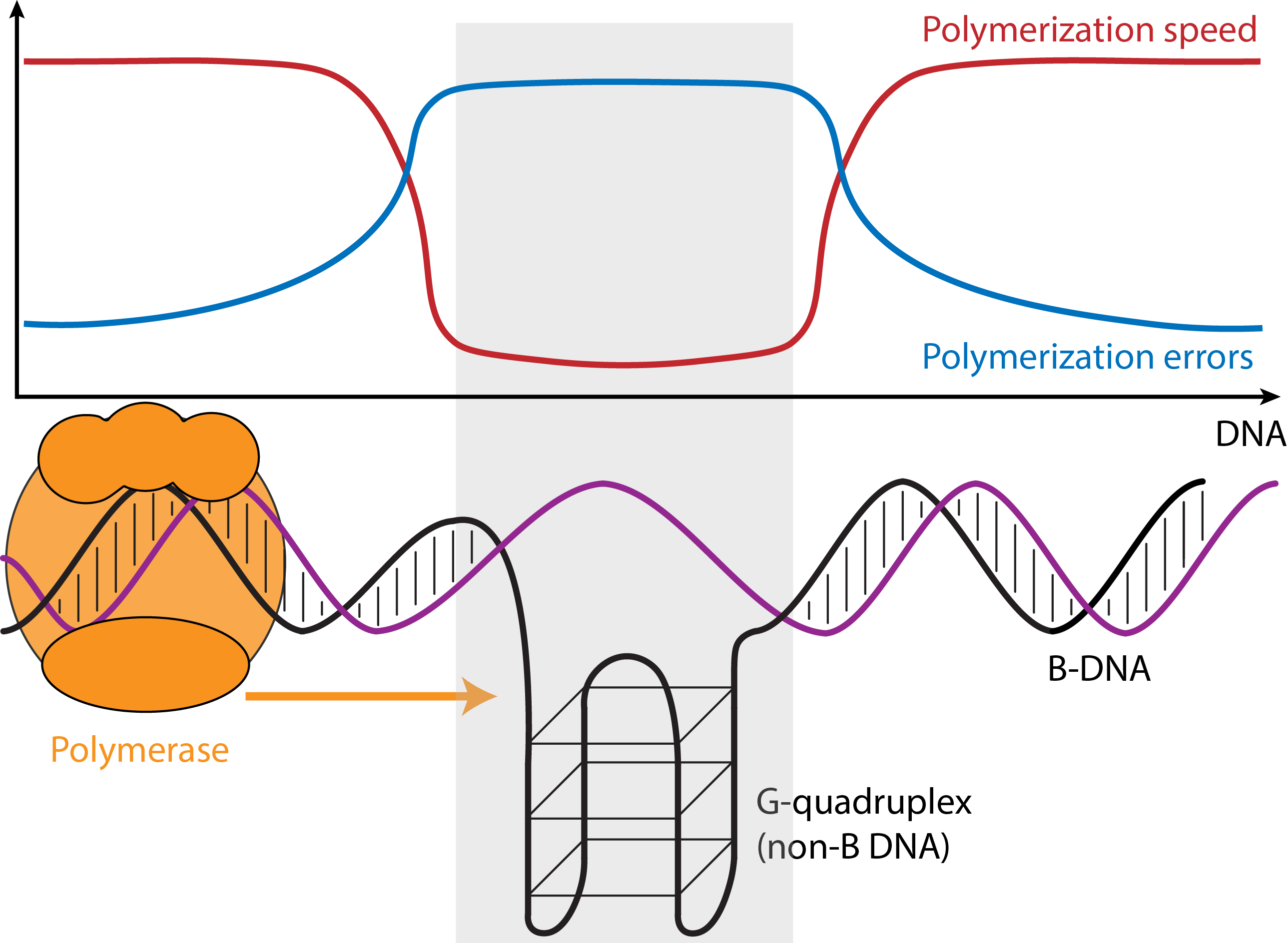
Credit: Wilfried Guiblet
Approximately 13% of the genome can fold into DNA structures different from the B-form double-helix discovered by Watson and Crick. Such “non-B DNA” structures include cruciforms, triplexes, slipped-strand structures, G-quadruplexes (G4s), Z-DNA, and bent DNA. They form at certain DNA sequence motifs that are ubiquitous in the genomes of prokaryotes and eukaryotes. Non-B structures form intermittently and can be stabilized under certain conditions in the cell. They are emerging as key regulators of many cellular processes (e.g., replication and transcription), which may be sensitive to the environment and to temporal signals associated with cell cycle and development. Non-B DNA also affects mutation rates. Despite their clear importance in the genome, non-B DNA motifs have been critically underexplored, and studying their evolution will bring us closer to deciphering their functions in the cell. Note that many microsatellites form non-B DNA.
Collaborators: Kristin Eckert and Francesca Chiaromonte
Members
 Huiqing Zeng
Research Technologist
Huiqing Zeng
Research Technologist
 Jacob Sieg
Postdoctoral Scholar
Jacob Sieg
Postdoctoral Scholar
 Marie Kratka
Postdoctoral Scholar
Marie Kratka
Postdoctoral Scholar
 Mayra Mendoza Cerna
Postdoctoral Scholar
Mayra Mendoza Cerna
Postdoctoral Scholar
 Saswat Kumar Mohanty
Ph.D. Student
Saswat Kumar Mohanty
Ph.D. Student
Collaborators


Press Releases
Beyond the double helix: Alternative DNA conformations in ape genomes
UNIVERSITY PARK, Pa. — Certain DNA sequences can form structures other than the canonical double helix. These alternative DNA conformations — referred to as non-B DNA — have been implicated as regulators of cellular processes and of genome evolution, but their DNA tends to be repetitive, which…